Most water-based cold chain systems in the field today are qualified and ship product within its required range. But meeting qualification and eliminating operational risk are not the same thing. Every water-based system carries a set of built-in constraints: seasonal pack-out changes, equilibration periods, exposure to cold shock, and the inability to hibernate. Teams running these systems daily have usually learned to work around these constraints rather than eliminate them. Phase change material (PCM) coolants address these constraints directly, because they are engineered to reach and hold their target temperature in a fundamentally different way than water. That difference is what allows PCM to deliver the four benefits detailed in this paper. For teams currently running water-based systems, understanding these benefits and the impact on their operation are the keys to evaluating a transition to PCM.
Precise Temperature Control
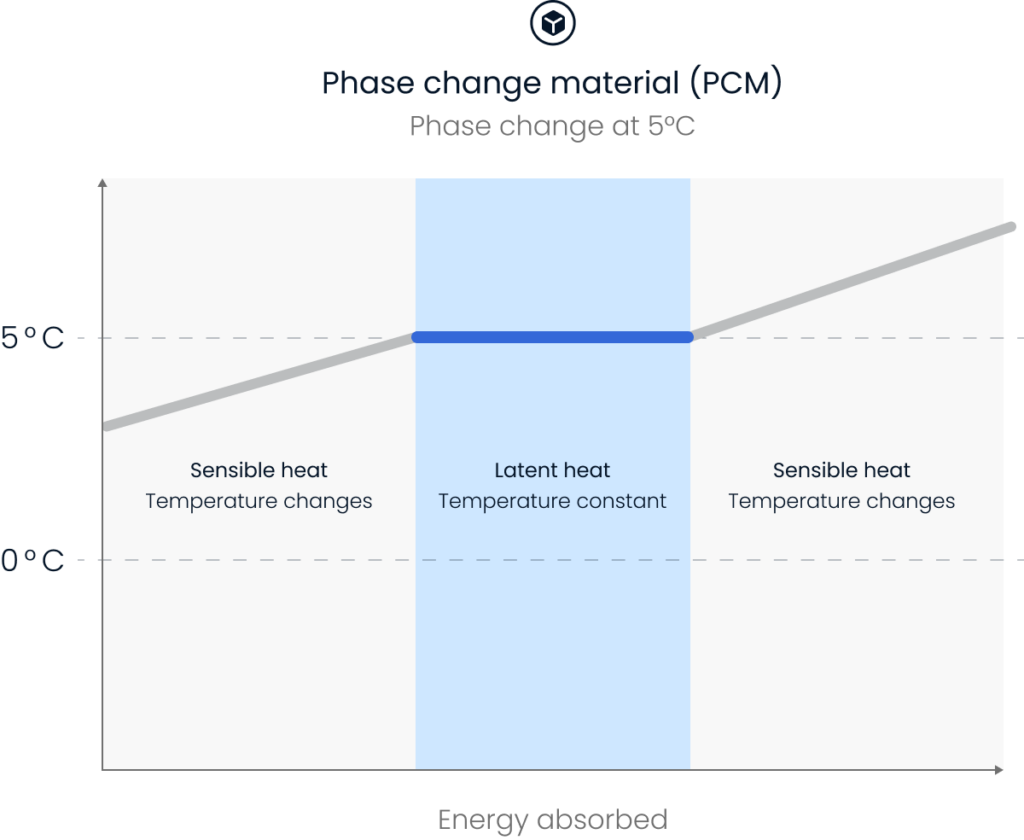
Phase change material (PCM) coolants are engineered with a defined phase-change temperature that aligns closely with the required temperature range of the payload. During the transition between solid and liquid states, the PCM absorbs or releases thermal energy while remaining close to this designed temperature. This allows the packaging system to maintain a stable and controlled thermal environment around the product.
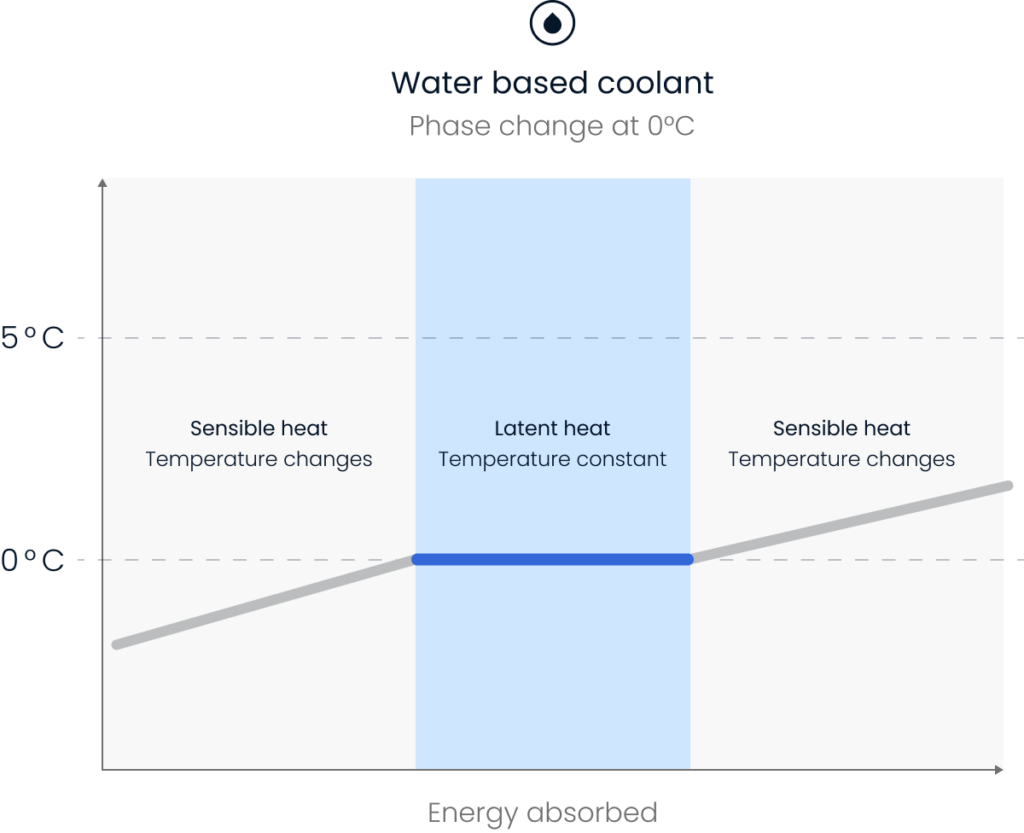
Water itself is also a phase change material, undergoing a solid-to-liquid transition at 0°C. However, unlike engineered PCM coolants, its phase-change temperature cannot be tailored to the requirements of temperature-sensitive products. As a result, water-based systems achieve temperature control indirectly rather than through a phase change that occurs at the desired product temperature.
For chilled applications, water-based systems typically combine frozen and chilled coolant components to create a thermal balance, known as equilibration, between two significantly different starting temperatures. Controlled room temperature water-based systems rely primarily on sensible heat, with the coolant temperature continuously changing as it absorbs or releases thermal energy. In both cases, the system works by managing the interaction of coolant at different temperatures, rather than maintaining the payload close to a purpose-engineered phase-change temperature.
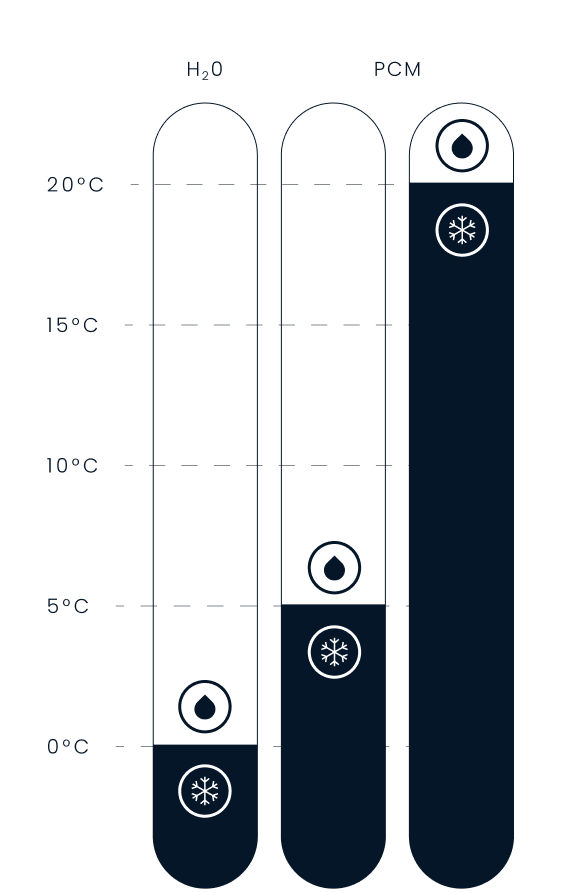
By using latent heat at a phase-change temperature selected specifically for the application, PCM provides more targeted temperature control. Rather than depending on the interaction between multiple coolant temperatures, the coolant itself operates close to the temperature the payload requires.
“A water-based system asks two different coolant temperatures to meet in the middle. PCM coolants operate near the targeted temperature. That single difference explains most of the operational complexity we see teams managing when deploying water-based solutions.”
– Fraser MacDonald, Sr. Specialist of Technical Solutions, CSafe
What Is the Difference Between Latent Heat and Sensible Heat?
Sensible Heat
Sensible heat is the energy absorbed or released by a material that causes its temperature to change, without changing its physical state.
For example:
Water at 5°C warms to 6°C.
Water at 20°C cools to 19°C.
In both cases, the water’s temperature changes, but it remains liquid. The heat exchanged is sensible heat because it can be “sensed” or measured directly as a temperature change.
Latent Heat
Latent heat is the energy absorbed or released during a phase change, while the material’s temperature remains essentially constant.
For example:
Ice at 0°C melts into water at 0°C.
Water at 0°C freezes into ice at 0°C.
Although a large amount of energy is absorbed or released, the temperature does not change until the phase transition is complete.
The same principle applies to engineered PCMs.
For example:
A PCM designed to melt at +5°C will:
Absorb heat while melting at approximately +5°C
Release heat while freezing at approximately +5°C
Throughout the phase change, the PCM remains close to +5°C, despite exchanging a significant amount of thermal energy.
Year-Round, Universal Pack-Out
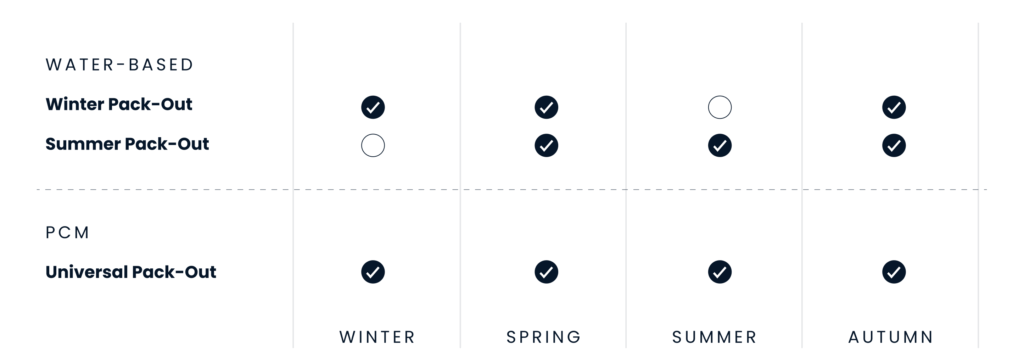
Engineered PCM coolants are conditioned to a single temperature that closely matches the required payload temperature. As a result, the same coolant conditioning process and pack-out configuration can typically be used throughout the year, regardless of seasonal ambient conditions. Because the coolant is already at, or very close to, the desired operating temperature, the payload begins its journey within the intended thermal environment immediately after packing.
Water-based systems often require seasonal adjustments to optimize performance. For chilled applications, this may involve altering the ratio of frozen and chilled coolant to compensate for changes in expected ambient temperatures, resulting in different summer and winter pack-out configurations. In addition, because frozen coolant is typically conditioned at approximately -20°C, the assembled shipment undergoes an equilibration period as heat flows through the system and the coolant transitions towards the target operating temperature.
By eliminating the need for seasonal pack-out changes and post-packing temperature equilibration, PCM provides a simpler, more repeatable process that reduces operational complexity while delivering consistent thermal performance throughout the year.
Reduced Risk of Cold Shock
Cold shock is the unintended cooling of a payload below its validated lower temperature limit, typically occurring when the packaging system does not achieve the thermal equilibrium for which it was designed and qualified.
A water-based +2°C to +8°C system relies on the transfer of thermal energy from the surrounding environment and/or payload to drive the frozen coolant through its phase change from ice to water. These systems are typically designed and qualified for assembly under ambient conditions of approximately +20°C, allowing the frozen coolant, conditioned at approximately -20°C, to progressively absorb heat and equilibrate towards the intended operating temperature.
If sufficient thermal energy is not available, the system cannot achieve this thermal equilibrium as intended. This may occur where shipments are packed or stored in refrigerated environments, preventing the frozen coolant from absorbing enough heat, or where the payload thermal mass is insufficient to facilitate the intended equilibration process. In either case, the frozen coolant remains significantly colder than the required payload temperature, increasing the potential for the payload temperature to fall below its validated lower limit.
To mitigate this risk, water-based systems often require additional operational controls, including ambient bench-rest periods, insulating buffer layers between the coolant and payload, minimum payload requirements, and restrictions on packing or storing assembled shipments within refrigerated environments. These controls are intended to ensure that the system reaches its validated operating condition before transport begins.
Engineered PCM coolants fundamentally remove this mechanism. Because the coolant is conditioned to a single temperature selected to closely match the required payload temperature, there is no requirement for the coolant to warm from deeply frozen conditions before it reaches its operating state. The shipment therefore begins its journey with the coolant already at, or very close to, its intended operating temperature, significantly reducing the dependence on environmental conditions, payload thermal mass, or operator-controlled equilibration procedures.
In essence, a water-based system relies on the surrounding environment and payload to provide the thermal energy required to establish its operating temperature, whereas an engineered PCM system is conditioned directly to its operating temperature before packing begins.
Ability to Pause or Extend Shipment Time
One of the unique advantages of engineered PCM coolants is their ability to effectively enter a hibernation state when stored under appropriate temperature conditions. If an assembled shipment is placed into an environment maintained at, or as close as possible to, the PCM’s phase-change temperature, there is minimal thermal energy entering or leaving the shipper. As a result, the PCM undergoes little or no additional phase change and retains its latent heat capacity until transportation resumes. This enables a shipment to be paused during planned storage or unexpected delays without significantly reducing its remaining thermal performance.
The effectiveness of hibernation depends on maintaining storage temperatures close to the PCM’s engineered phase-change temperature. Under these conditions, the PCM remains in a stable thermal state and does not continue to consume its stored latent heat. Once the shipment is returned to a warmer transport environment, the PCM resumes absorbing heat from the surroundings exactly as if the interruption had not occurred, allowing the remaining validated shipment duration to be utilized.
Water-based systems do not provide an equivalent mechanism. Chilled water-based coolant contains no latent heat reserve and therefore continues to respond through sensible heat exchange. Frozen water-based coolant can only recover its thermal capacity by returning to freezing conditions, typically requiring temperatures below 0°C, which are generally not available during routine shipment holds or refrigerated storage. Consequently, time spent in storage continues to consume the available thermal performance of the system rather than preserving it.
In essence, an engineered PCM system can temporarily pause its thermal performance when stored at its operating temperature, whereas a water-based system continues to consume its available thermal capacity throughout the storage period.
Choosing the Right Coolant for Your Shipment
For teams managing water-based systems, the advantages gained from PCM coolant are worth considering: less operational complexity, reduced risk of product loss, and PCM’s ability to hibernate during unexpected delays. Water-based coolant remains a valid, well-understood option for many lanes and product profiles, so this isn’t a case for retiring it outright. It is a case for evaluating PCM on the lanes and products where these benefits matter most. CSafe designs and manufactures both PCM-based and water-based temperature-controlled packaging solutions, and can help evaluate whether moving to PCM would meaningfully reduce risk or operational complexity for a specific product, lane, and shipping profile.
Key Takeaways
- PCM coolants are engineered with a phase-change temperature that matches the payload’s required range, so the coolant itself operates at the temperature the product needs; water-based systems control temperature indirectly, by managing the interaction between coolant components at different temperatures.
- PCM coolants conditioned close to the payload’s target temperature typically use the same pack-out configuration year-round; water-based systems, which often combine frozen and chilled coolant components to reach the target range, may require different summer and winter configurations, adjusting the ratio of frozen to chilled coolant, to compensate for seasonal ambient shifts.
- PCM coolants are already conditioned to the operating temperature before packing, removing the need to rely on ambient or payload heat to reach that temperature; water-based systems depend on that heat to drive frozen coolant through its phase change to reach operating temperature, and insufficient heat, such as when a shipment is packed or stored in a refrigerated environment, can leave the coolant colder than the payload and increase the risk of cold shock.
- A PCM coolant stored near its phase-change temperature enters a hibernation state that preserves its latent heat capacity until transport resumes; chilled water-based coolant has no such latent heat reserve and therefore is unable to hibernate and pause or extend shipment time.
- PCM and water-based coolants both remain valid options in cold chain packaging; teams managing water-based systems can work with CSafe to evaluate whether PCM would reduce risk or operational complexity for their shipments, based on the specific product, lane, and operational profile.
Shared knowledge. Better outcomes.
CSafe brings real-world experience to every customer conversation. Speak with a CSafe specialist about your lanes, product profile, and container requirements.