Pharmaceutical cold chains are designed around temperature control. The challenge today is that the thermal environment surrounding those systems has intensified. Three of the world’s leading scientific organizations have independently documented the same trend:
- The World Meteorological Organization confirms that 2015 to 2025 were the hottest 11 years on record,¹ and that heatwaves are becoming more frequent, more intense, and increasingly concurrent across multiple regions.²
- NOAA’s 175-year climate record shows the 10 warmest years have all occurred within the past decade.³
- NASA’s 146-year record shows 2023, 2024, and 2025 as the three warmest years ever measured.⁴
The extreme temperatures being experienced across the Northern Hemisphere this summer are not isolated events, and unfortunately, they are not likely to be the last.
Cold chain specifications that have not been reviewed against current ambient temperature data may not reflect the real-world conditions shipments now encounter. CSafe’s portfolio addresses cold chain heat exposure at every stage, from air freight to last mile delivery. As ambient conditions intensify, the following solutions address heat exposure at key points across the journey.
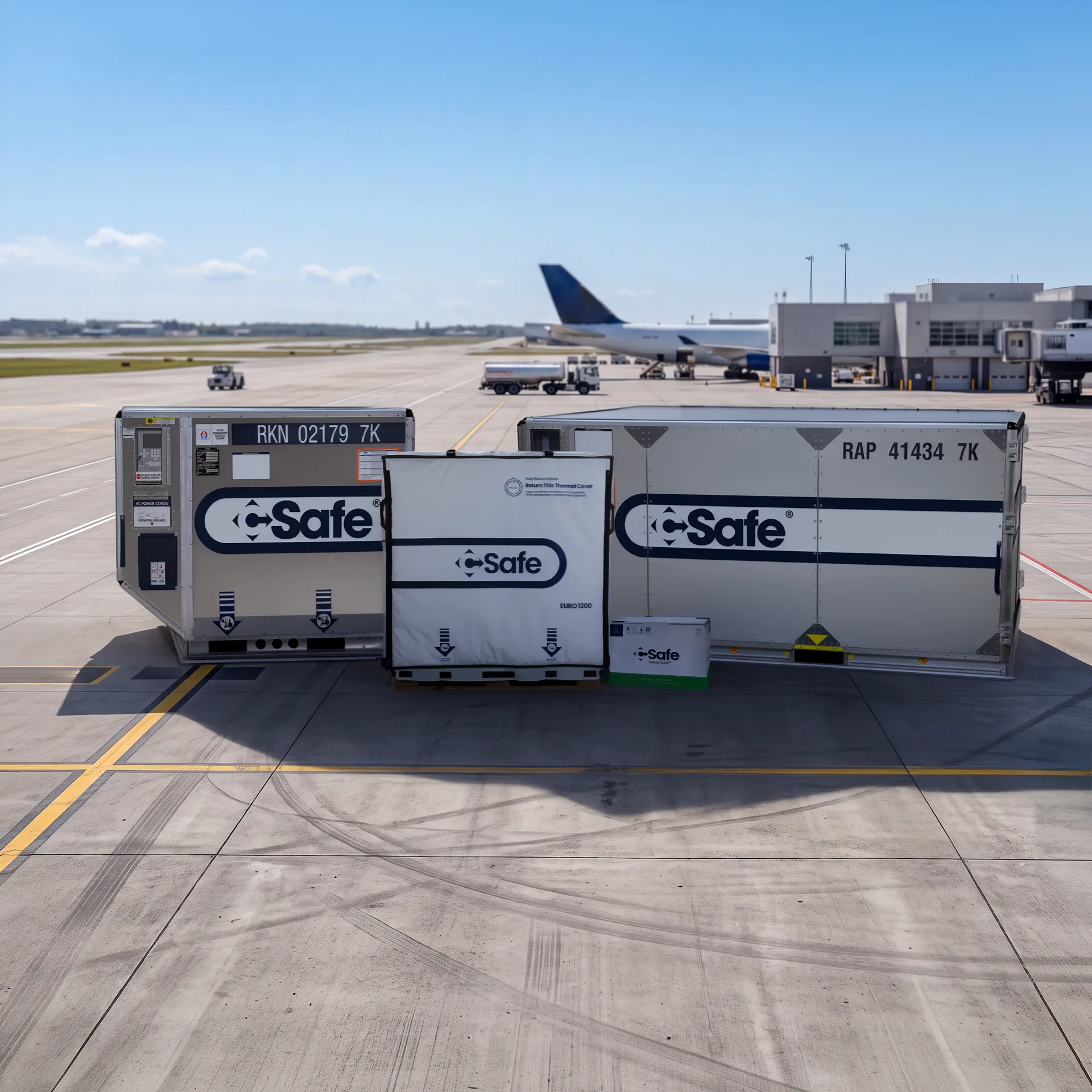
Active Control for Air Freight — CSafe RAP and CSafe RKN
When ambient temperatures exceed the operating window of passive bulk air-cargo solutions, active temperature-controlled containers are the appropriate specification.
The CSafe RAP is a multi-pallet active container that maintains precise payload temperatures in ambient conditions from -30°C to +54°C. It runs for 120+ hours on internal battery power. The CSafe RKN is the single-pallet equivalent, operating across the same lower bound with an upper ambient range of +49°C and a run time exceeding 130 hours. Both use compressor-driven cooling and an air recirculation system that actively conditions the cargo chamber, autonomously, throughout the shipment.
User-selectable set points from +4°C to +25°C in 1°C increments give operations teams precise control over payload temperature regardless of what the environment outside the container is doing.
Extended Protection for Distribution and Last Mile — CSafe Advanced
Ground distribution and last mile delivery expose shipments to conditions that are difficult to anticipate. From the distribution center to the delivery vehicle to the final drop point, shipments move through environments where ambient temperature is largely uncontrolled and dwell times are unpredictable.
For those conditions, CSafe Advanced parcels combine vacuum insulation (VIP) technology, PCM coolant, and a simple universal pack-out configuration to deliver true 72-hour ISTA 7D thermal performance.
Ramp and Tarmac Protection — SilverSkin Thermal Covers
Even when using temperature-controlled lanes, shipments can face uncontrolled heat exposure during ramp handling and aircraft loading. Direct solar radiation and reflective heat from ground surfaces create thermal stress during that transfer window.
SilverSkin thermal covers reduce radiant heat transfer to the shipment during ramp and tarmac exposure. CSafe offers SilverSkin in a single-use format and as SilverSkin RE, a reusable option for organizations with sustainability targets alongside performance requirements. Cover selection should take into account the anticipated ambient temperature and the duration of ramp and tarmac exposure for the specific lane as well as other factors such as payload mass and product stability temperature range.
Visibility During Transit — CSafe Connect
The CSafe RAP and CSafe RKN transmit real-time telemetry to CSafe Connect, CSafe’s cloud-based shipment management platform. Logistics teams can monitor payload and ambient temperature data while the shipment is in transit and receive automated alerts if conditions near excursion thresholds.
CSafe Connect also stores historical lane data. That record supports proactive analysis for identifying routes and transfer points that carry elevated heat risk during specific periods. Secure API integration can provide shipment data directly into the customer’s internal systems.
Key Takeaways
Extreme heat creates risk at every stage of a pharmaceutical shipment. CSafe’s portfolio addresses that risk from air freight to last mile delivery.
The CSafe RAP active container maintains precise payload temperatures in ambient conditions from -30°C to +54°C, with a battery run time exceeding 120 hours. The CSafe RKN maintains payload temperatures in ambient conditions from -30°C to +49°C, with a run time exceeding 130 hours. Both deliver continuous, autonomous temperature control independent of the ambient heat conditions surrounding them throughout the shipment.
CSafe Advanced parcels use vacuum insulation (VIP) technology to deliver true ISTA 7D 72-hour thermal performance, with a simple, PCM-based universal pack-out configuration.
SilverSkin thermal covers reduce radiant heat transfer to shipments during ramp handling and aircraft loading, exposure points that can be incurred even when using temperature-controlled lanes.
Real-time telemetry through CSafe Connect gives logistics teams the ability to monitor payload and ambient conditions during transit and receive automated alerts if conditions near excursion thresholds. Historical lane data in the platform supports proactive lane specification reviews.
Shared knowledge. Better outcomes.
CSafe brings real-world experience to every customer conversation. Speak with a CSafe specialist about your lanes, product profile, and cold chain requirements.
Sources:
- ¹ World Meteorological Organization. State of the Global Climate 2025. https://wmo.int/publication-series/state-of-global-climate/state-of-global-climate-2025
- ² World Meteorological Organization. “Extreme Heat.” https://wmo.int/topics/extreme-heat
- ³ NOAA National Centers for Environmental Information. “Assessing the Global Climate in 2024.” https://www.ncei.noaa.gov/news/global-climate-202413
- ⁴ NASA Scientific Visualization Studio. “Record Temperature Years: 2025, 2024, and 2023.” https://svs.gsfc.nasa.gov/5607/