The global cold chain environment is more challenging — and more consequential — than ever:
- Expanding lane options
- Regional and seasonal temperature variability
- Infrastructure inconsistency
- Evolving product stability profiles
In this environment, sustainability is not a standalone initiative. It is the result of smarter, more resilient decisions—about how shipments are planned, protected, and executed across every handoff.

Start with What Matters Most: Get It Right the First Time
One of the most overlooked drivers of sustainability in pharmaceutical logistics is simple:
Ship it right the first time.
Every temperature deviation avoided eliminates the need for:
- Reshipment
- Additional manufacturing
- Emergency transport
- Product destruction
- Added carbon emissions
Reducing product loss is one of the most immediate and effective ways to lower environmental impact—while also reducing operational disruption and cost, and ensuring critical therapies reach patients as intended.
Because resilience doesn’t just protect product.
It protects resources, timelines, and confidence across the supply chain.
Smarter Positioning. Lower Impact.
Sustainability begins before a shipment even moves.
By leveraging AI, machine learning, and predictive analytics, CSafe optimizes container positioning across its global network—helping ensure the right equipment is available where and when it’s needed.
CSafe’s AI-powered demand forecasting system:
- Predicts container needs weeks in advance
- Positions equipment closer to demand
- Reduces empty repositioning and excess transport
- Minimizes bottlenecks across global logistics networks
This proactive, data-driven approach reduces emissions while improving planning reliability and execution consistency for customers and logistics partners.
What Does CSafe’s Approach to Sustainability Include?
CSafe’s sustainability approach is embedded across every layer of operations:
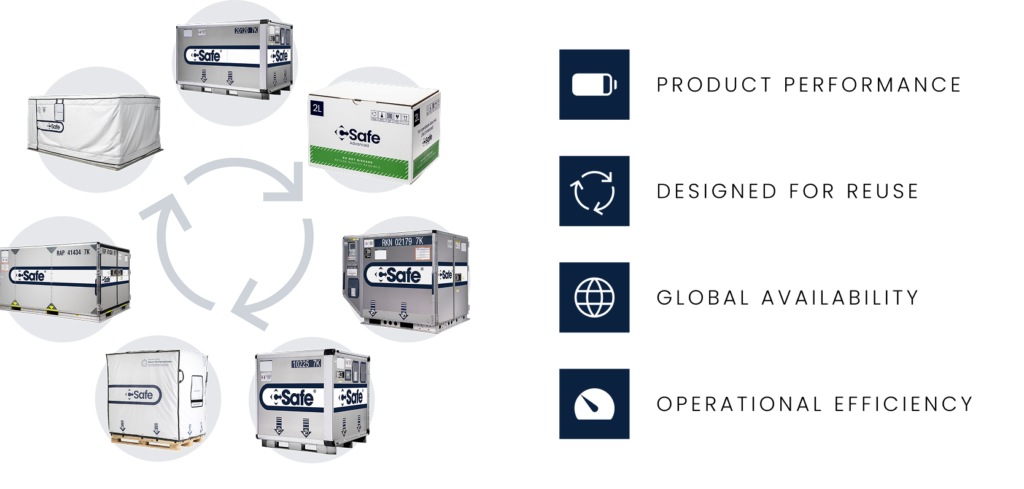
- Product Performance: Environmental responsibility is impossible without reliability. Preventing temperature excursions eliminates waste at the source and ensures product integrity throughout the journey.
- Designed for Reuse: Reusable solutions reduce raw material consumption and minimize lifecycle waste while supporting repeatable, scalable operations.
- Global Availability: A strategically positioned global service network minimizes transportation distances and associated emissions, reduces delays, and supports more predictable execution.
- Operational Efficiency: Continuous improvements drive ongoing reductions in waste and energy consumption while enhancing consistency across the network.
How Does CSafe Measure Its Sustainability Performance?
Sustainability commitments are only meaningful when they are measurable and transparent. CSafe supports its approach with structured environmental tracking and recognized frameworks:
- Science-Based Targets: Near-term greenhouse gas emissions reduction targets approved by SBTi
- Scope 1, 2 & 3 Emissions Tracking: Continuous monitoring across direct operations and the broader value chain.
- Product GHG Inventory Analysis: Partnering with leading sustainability experts to assess emissions across the product portfolio and identify reduction opportunities.
- EcoVadis Certifications: Recognized sustainability performance across global operations.
- Carbon Disclosure (CDP): Transparent reporting aligned with global disclosure standards.


How Does CSafe Match Protection to Each Lane?
CSafe delivers a full spectrum of temperature-controlled solutions—including autonomous active containers, passive pallet systems, and thermal covers—enabling tailored strategies for each lane, risk profile, and operational requirement.
Sustainability, Built Into Every Shipment
In modern pharmaceutical logistics, sustainability is not achieved through offsets or after-the-fact corrections. It is built through prevention, precision, and performance.
The most sustainable supply chains are those that:
- Prevent loss
- Optimize movement
- Maximize reuse
- Operate with data-driven precision
Because when every shipment is planned with greater accuracy, protected with proven performance, and executed with consistency, sustainability becomes not just a goal—but a built-in outcome of every delivery, supporting reliable access to the therapies patients depend on.